
Impact Evaluation & Socio-Economic Assessment
Measure what your work actually changes
Funders, commissioners and communities want to know what difference you make. We give you the evidence — in outcomes, in social value, and in pounds — and the tools to keep measuring after we leave.
What we deliver
- Theory of change and impact frameworks — what you are trying to change, how, and the indicators that show it.
- Socio-economic impact assessment — jobs, GVA, wellbeing and distributional effects of a project or programme.
- Social value analysis — monetised outcomes for tenders and funding bids.
- Independent programme evaluation for funders such as The National Lottery Community Fund and local authorities.
- Impact management systems — embedding data collection and evaluation into everyday decision-making, so evaluation becomes a habit rather than a report.
Methods and standards
- HM Treasury Magenta Book — evaluation scoping, design and reporting
- Logic models and indicator sets built with your team, not handed to them
- Process, impact and value-for-money evaluation, singly or combined
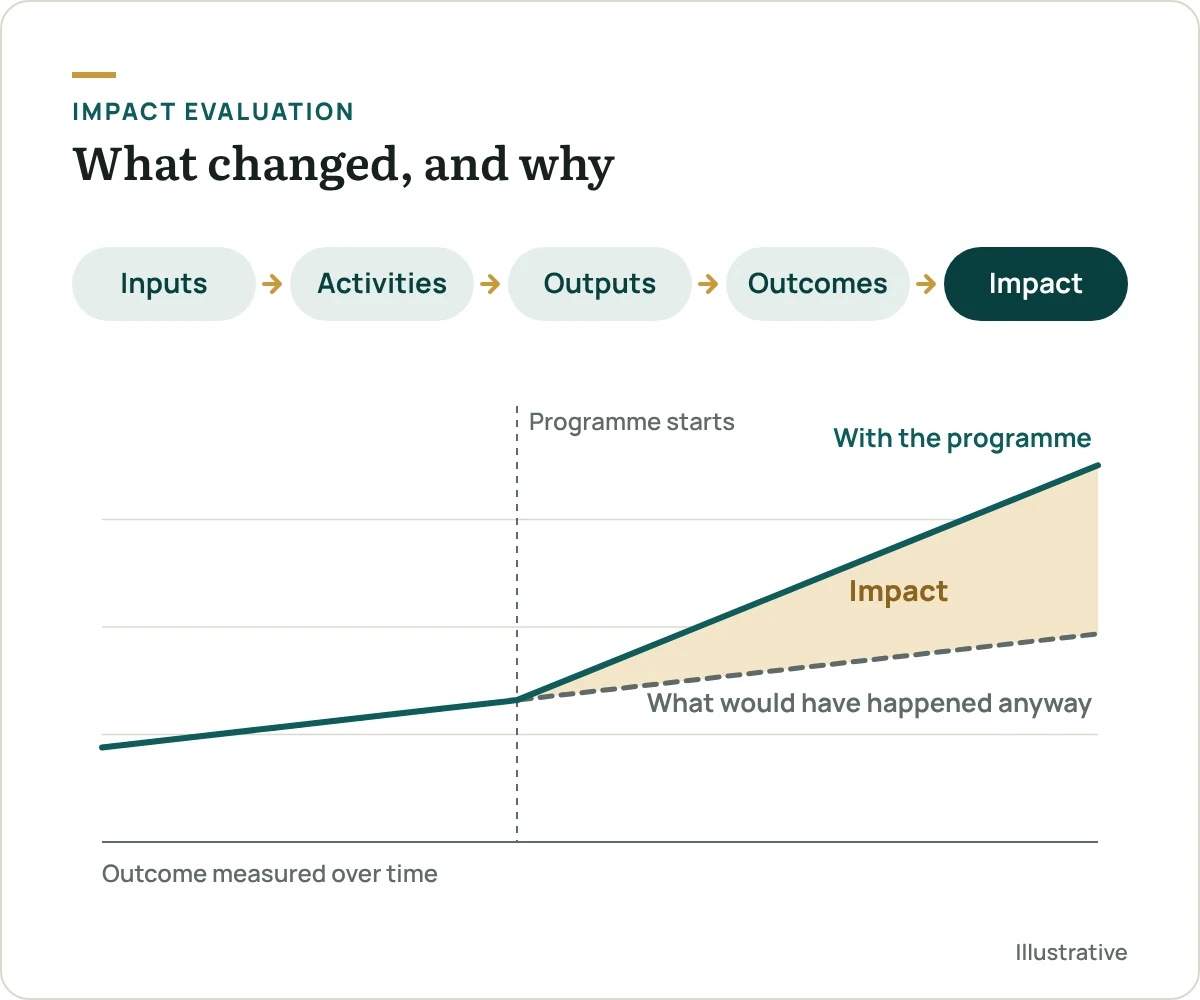
- Additionality assessment — deadweight, leakage, displacement, substitution and multiplier effects, following the established UK additionality framework
- Counterfactual design where data allows; contribution analysis where it honestly does not
- Social Return on Investment principles — scope, stakeholders, outcomes, proxies, discounting, sensitivity
- Outcome monetisation using recognised unit-cost and social-value databases, with proxies disclosed
- Mixed-method evidence — surveys, administrative data and interviews with thematic analysis
Who it is for
Charities and social enterprises reporting to funders · Councils and public bodies evaluating programmes · Developers and infrastructure projects needing an economic impact assessment · Funders commissioning independent evaluation.
How it works
- Agree the questions the evaluation must answer and who will use the findings.
- Build or refine the theory of change and indicator set.
- Collect and analyse the data.
- Quantify outcomes and, where appropriate, monetise them.
- Report the findings, with the tools to keep measuring.
Related work
Recent engagements

Grant funding
Independent review of a National Lottery application
Criterion-by-criterion review of a Reaching Communities application before submission, including its outcomes and evidence.
More of our work
Case studies across culture, regeneration, energy, community enterprise and grant funding, plus the charities and community organisations we support.
Show the difference you make
Tell us who you report to and what they ask for. We will design an evaluation that answers it.